What Happened
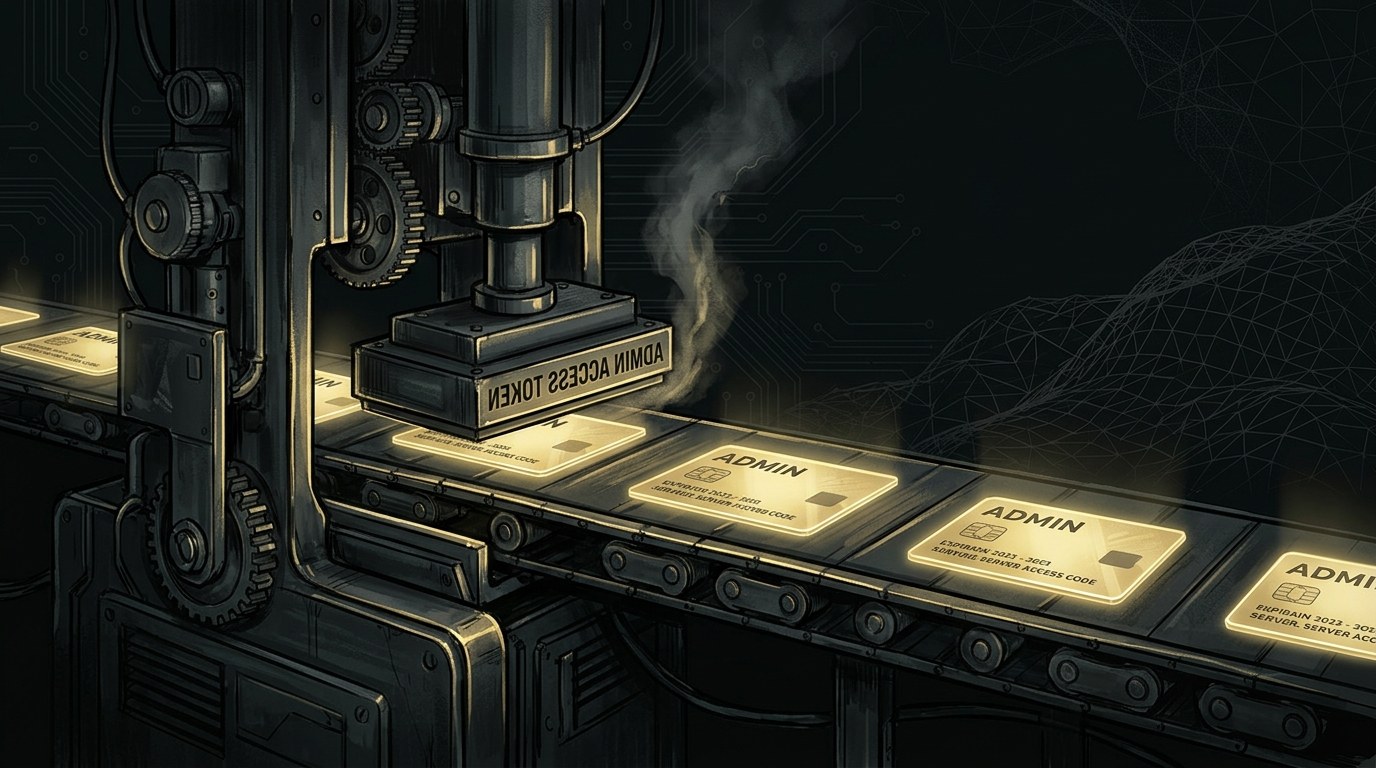
On September 1–2, security researchers and vendors disclosed active exploitation of CVE-2026-82329, an authentication-bypass flaw in JFrog Artifactory rated CVSS 9.8. In the default configuration, an unauthenticated attacker can bypass the auth layer and issue valid administrator access tokens for themselves. There is no stolen password in this chain, no phished passkey, no reused legacy credential. The vulnerability hands the attacker the token-minting machinery directly.
The observed post-exploitation behavior is exactly what you would fear from a compromised artifact registry. Attackers are enumerating users, groups, stored credentials, and the federated access topology — the map of which systems trust which — and then poisoning the packages that Artifactory serves to downstream build systems. Those build systems pull and execute the tampered artifacts automatically. One forged admin token at the registry becomes malicious code running inside every pipeline that trusts it. Self-managed enterprise instances took the hit; JFrog's cloud was already patched before the window opened.
Stealing a Token and Minting One Are Not the Same Threat
Most of the auth industry is organized around a single assumption: the credential is a secret worth stealing. Rotate it, shorten its lifetime, bind it to a device, put it behind a hardware key — the entire discipline of credential hygiene exists to keep the secret from being copied. Every one of those controls is defeated the moment the attacker stops copying secrets and starts issuing them.
That is the shift CVE-2026-82329 represents. The attacker is not impersonating a valid admin by holding their token. The attacker is a valid admin, cryptographically, because the system that issues authority was tricked into issuing it. Rotation does not help — the forged token is freshly minted. Short lifetimes do not help — it can be re-minted at will. Device binding does not help — it never went through a device. When token issuance itself is compromised, every downstream control that trusts the token is compromised with it, silently and at machine speed.
A Forged Token Has No Human Behind It
A token can look valid while still lacking the authorization context an application requires. Systems can reduce that risk by verifying scoped, human-approved authority independently of the token's role claim.
This is the entire premise of BioAuth's Power of Agent (PoA). PoA is designed to let applications require scoped human-approved authority and a signed receipt before accepting a supported agent action. Applications remain responsible for validating that evidence and enforcing their own authorization policy.
Under a PoA-governed pipeline, an application can require that additional authorization record for sensitive operations. If the required authority or receipt is absent or invalid, the application can deny the action regardless of whether the presented token appears structurally valid.
The Supply Chain Is Now an Identity Problem
The reason this story matters beyond one CVE is the target. Artifactory sits at the center of the software supply chain. When its token issuance is compromised, every SDK, every internal library, every container image it serves becomes a breach candidate for every organization downstream. This is not a login problem and it is not a recovery problem. It is an authority problem: the build system trusted a token, and the token was a lie the system told itself.
For any platform that hosts Artifactory — or any registry, secrets store, or CI/CD identity provider — the lesson is that hardening the credential is no longer sufficient, because the attacker has stopped attacking the credential and started attacking the issuer. The durable defense is to make sensitive actions subject to independently verified authorization context. When issuance is the attack surface, separating the business authorization decision from the token's role claim provides another enforceable control.
The Takeaway for the Enterprise
Patch CVE-2026-82329 today if you run self-managed Artifactory — that is not in question. But the pattern outlives this one advisory. As attackers move from stealing identity tokens to manufacturing them, the controls built to protect secrets stop protecting anything, and the only thing left standing is whether a real, verified human authorized the action.
When token issuance is compromised, independently verified authorization context still matters. A system using Power of Agent can require scoped human-approved authority and a valid receipt before accepting a supported sensitive action.